
One of my child’s first word was “go”, more specifically “go go go”. I guess being born in the U.S. this should not come as a surprise. We are so used to constantly moving or going that our language has, at times, suffered. We find ourselves so busy that we have an overwhelming desire for someone to get to the point. This way of talking or writing can be very beneficial and has it’s purpose especially when delivering information. Which is what our culture has embraced fully. This could be due to the rise of the internet and 24-hour news coverage where information has almost become a commodity. What has suffered in this “go go go” society is the idea behind prose, poetry, and other flowery forms of writing. Consider a sunrise. I might say “it’s a beautiful sunrise today”. I may add in some color descriptions but for the most part I will usually get to the point quickly. Now look at how Emily Dickinson describes a sunrise from her poem
I’ll tell you how the Sun rose
A ribbon at a time
The steeples swam in amethyst
The news, like squirrels, ran
The Hills united their bonnets
the bobolinks-begun-
Then I said softly to myself
“That must be the Sun!”
But how he set-I know not
There seemed a purple stile
Which little yellow boys and girls
Were climbing all the while-
Till when they reached the other side,
A dominie in gray
Put gently up the evening bars
and led the flock away.
Emily Dickinson “I’ll tell you how the sun rose”
What is interesting is when one reads the whole poem they should be drawn to its religious undertones with the concluding phrase “And led the flock away”. Not only does she do a much better job describing a sun rise than I could but also adds in a hint faith. In fact, often this is what poetry does. It describes something beautifully while at the same time drawing our attention to something else in a comparative way. If we try to read poetry for information it is very likely we will completely miss this comparison or miss a deeper idea that is not being explicitly said. This is why we remember songs so well. When we are told information we will often forget it but when we are required to think about something and piece together what is being said through imagery we will remember these things better. Often song, which is a form of poetry, provides this avenue of discovery. Granted there is information in the song but if we only focus on the information, we will often miss the deep and raw emotion being conveyed through rhythm and melody.
Yet in our busy lives this is what we do to the book of Genesis. We want to have all the answers to life’s deepest questions. Christians have been taught that the Bible is the place where we can find all these answers. So, when a question such as “how did we get here” is asked we would tend to look to the Bible for information. When we do this, we see that there are seven days, a clear a single couple formed from dirt, a talking serpent, and an exile. What this means is that the Bible is just factually giving us the information we need to know where we came from or how we got here. Reading Genesis like this will invariably allow one to miss the underlying deeper ideas that the author was trying to convey. By reading Genesis for information instead of as prose or poetry we miss some deep theology about God.
When reading Genesis in its original language (Hebrew) we will see the first sentence contains 7 words בְּרֵאשִׁ֖ית בָּרָ֣א אֱלֹהִ֑ים אֵ֥ת הַשָּׁמַ֖יִם וְאֵ֥ת הָאָֽרֶץ. In the middle of this sentence is the word אֵ֥ת (et) this word uses the first and last letter of the Hebrew alphabet. This should clue the average Christian to Jesus saying “I am the alpha and omega; the first and last” because the alpha and omega are the first and last letter of the Greek alphabet. Here in the first sentence of Genesis we see themes that are being introduced that can not be seen if it is read for information and not as poetry. We see the importance of the number seven and that God, the object of Genesis 1, is the center as well as the beginning and end of everything.
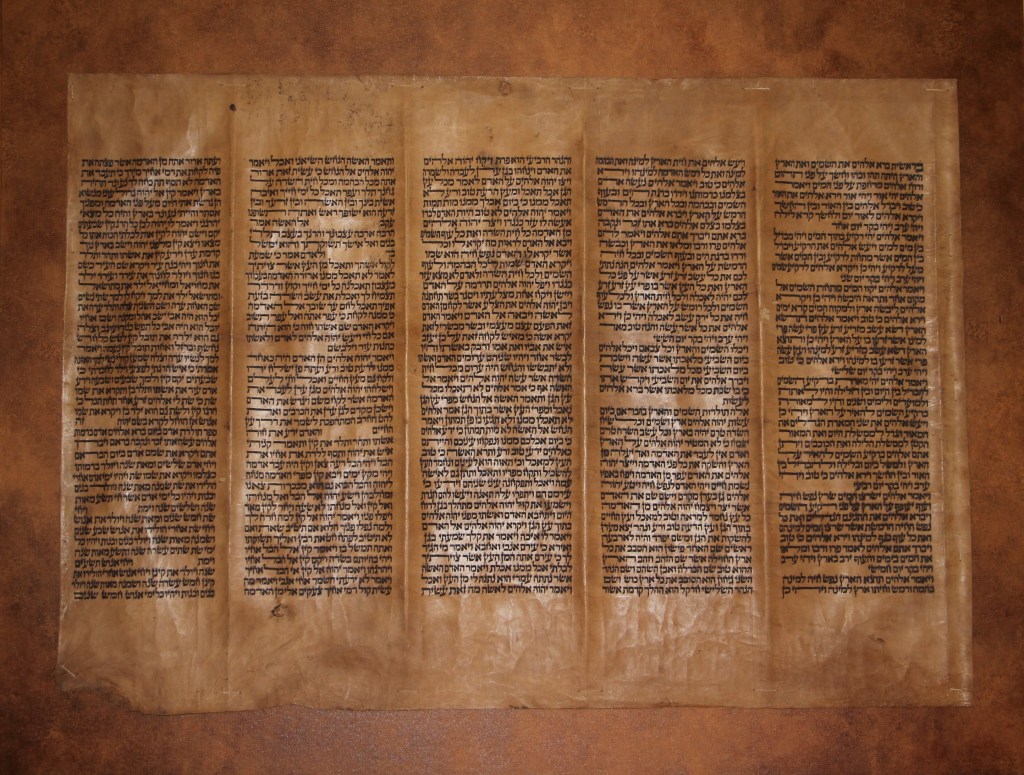
After this introduction (verses 1 and 2) the creation event described in Genesis is divided into seven paragraphs verse 3 through chapter 2 verse 3). Each new paragraph begins a new day (verses 3, 6, 9, 14, 20, 24, and 2:1). We need to remember the original way this was written was not how modern translations depict the structure of Genesis 1. This can be seen at verse 29 where the narrative changes from an act of creation to instruction. In today’s writing this would be a clear indication that a new paragraph is needed because the line of thinking changed. However, there was no necessary distinction to the ancient writer. To the author this was all “day six” and did not need a new paragraph. In this way each new paragraph corresponds with a new day of creation. The point is that the author is pointing to the significance of the number seven.
Further, there are ten utterances by God. These utterances can be divided into two groups first group is a group of seven and the last is a group of three. The first seven utterances join together the creation with the creature. In order they go like this “let there be light”, “let there be a firmament”, “let the waters be gathered together”, “let earth bring forth vegetation”, “let there be lights” (sun moon stars etc.), “let the waters teem”, “let the earth bring forth”. The next three are pronouncements regarding man. These are “let us make man”, “be fruitful and multiply”, and “look, I have given you ever seed bearing plant”. These final three are in regard to man’s welfare. This is an introduction on the importance of three throughout the Bible but I will leave that to your own reading for now. I am only looking at the number seven and its importance in the beginning chapter of Genesis.
When looking at the term “light” and “day” these terms occur seven times in the first paragraph (1:3 is paragraph one because verses 1 and 2 are introductory showing that when the author says “God” he is meaning “Elohiem” one God not a pantheon like the ancient Egyptians or Assyrians believed) with seven references to light in the fourth paragraph
In paragraphs two and three water is mentioned seven times. In paragraphs five and six living or beasts occur seven times. Six times the author writes “it was good” and on the seventh he writes “it was very good”.
The seventh paragraph which deals with the seventh day shows even more importance to the number seven and the number three. Here we see three consecutive sentences each contain seven words. In the middle of each of these three sentences contain the words “the seventh day”. Finally, the seventh paragraph contain 35 words which is five times seven.
Because of this the reader should clue into the importance of seven and three specifically. In fact, it is this numerical symmetry that binds this entire section together. This should be preparing the reader to clue into these numbers whenever they see them throughout scripture.
What does this mean for the “day is literal” debate? This is taking a piece of literature and trying to apply today’s understanding of writing into something that did not have that intention. We can not apply our understanding of “informational” writing to this book. This must be read as prose and poetry by doing so we will gain so much more insight on the character of God. By reading Genesis strictly as informational we will begin by misunderstanding the entire Bible. Why? Genesis acts as the foundation of everything else written through the Bible and is the foundation of understanding who Christ is. If we get this wrong it should be of no surprise that we will get other things wrong. With that being said it is highly doubtful that Genesis is a literal 7-day period. What Genesis does offer is an insight to God and His character and an introduction to how we should worship Him. Genesis is not meant to be a scientific book. It is a book to describe the characteristics of God to a specific audience at a specific time. It is not for us as a primary audience nor is it written to speak about scientific things.
Finally, when looking at day seven this day has not been completed. Opposed to the other days in the creation week the author does not mention the setting of the sun or “and there was evening and there was morning – the third day”. Because of this we are still living in the seventh day. What does this mean for a Christian? That God has given us everything we need to live in His creation. He has blessed these times we are currently living, even if they seem terrible, and everyday we live is a day of holiness dedicated to God even in the good and bad. The problem we have is that we get too caught up in our daily lives that we miss the great things God has already done for us. To us a blessing is something I have yet to receive, but to God the blessings are what He has already done. Consider that when God blesses the seventh day and called it very good it was because of everything that had already happened. He did not bless the seventh day and say “your blessings are forthcoming”. No, He considered the seventh day a blessing because of His previous work and because of who He is. If nothing else He alone is blessing enough.
For further reading: Umberto Cassuto “A Commentary on the Book of Genesis part one”

 Ransomed Ragamuffin
quite a heavy post with strong content, i must check back on this. Stopped by to say Hi and wish you well on your journey Ryan.
LikeLike