I LOVE to read the Bible and find new things that point to our ultimate Exodus from death into life through the cross of Jesus. Passover is one such example. At Passover, we see an unblemished lamb sacrificed, whose blood paints a wooden structure, and a people saved because of this sacrifice. There is more symbolism to Passover than this. But this story of the Exodus and Passover does not pertain to just one book. From the beginning, Adam and Eve saw their own Exodus from the Garden in Eden to wandering. Later, Noah would pass through the waters of death and into a new life. In fact, throughout the Bible, after Chapter 3, the rest of humanity is on an exodus journey from death and exile into one of life and a closer relationship with God. If this is true, we should be able to see how different stories Bible stories point to this type of Exodus with symbolism in the Passover and from these stories, ultimately see how they also point to Christ. The story of humanity in the Bible picks up with Abraham a few chapters after the flood. In several instances, one can draw many connections in Abraham’s life to a future Passover. But one story I will focus on here is the story of Sodom and Gomorrha. In case you need a refresher, please read Genesis 18:16-19:29. A few chapters earlier, Abraham and God make a covenant where God walks between 2 halves of a sacrificed animal that Abraham had prepared. Through this sacrifice, God not only establishes a covenant with Abraham but also demonstrates how God would deliver His chosen people. Israel’s path through the sea can be described as a journey through the walls of death which is mirrored not only by the water (remember Noah’s flood?) but by being surrounded by enemies upon entering the promised land. As God passes through the death from the sacrifice so will Isreal in the Exodus. Just as an aside, I do not think it is happenstance that in Genesis 15:17, God is represented passing through the sacrifice by a cloud and fire when compared to Ex 13:21-22. Also, it is difficult to talk only about Lot and Sodom without including Abraham since these two were so closely entwined in the story.
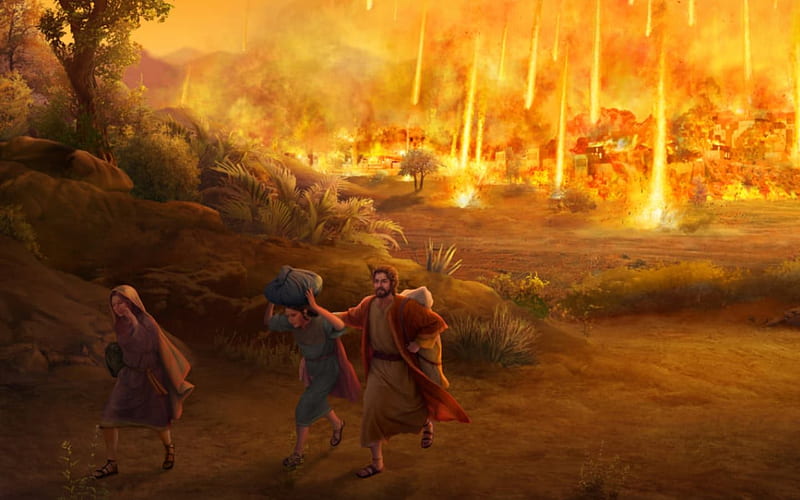
Lot’s Exodus out of Sodom
Festival of unleavened bread
Lot serves his divine guest’s unleavened bread (Gen 19:3).
This is important because in Exodus 12:14-20, God says to Moses, “This is a day you are to commemorate; for the generations to come you shall celebrate it as a festival to the Lord—a lasting ordinance. For seven days, you are to eat bread made without yeast. On the first day, remove the yeast from your houses, for whoever eats anything with yeast in it from the first day through the seventh must be cut off from Israel. On the first day, hold a sacred assembly and another one on the seventh day. Do no work at all on these days, except to prepare food for everyone to eat; that is all you may do. Celebrate the Festival of Unleavened Bread because it was on this very day that I brought your divisions out of Egypt. Celebrate this day as a lasting ordinance for the generations to come. In the first month (Nisan), you are to eat bread made without yeast from the evening of the fourteenth day until the evening of the twenty-first day. For seven days, no yeast is to be found in your houses. And anyone, whether foreigner or native-born, who eats anything with yeast in it must be cut off from the community of Israel. Eat nothing made with yeast. Wherever you live, you must eat unleavened bread.” Clearly, unleavened bread is a central aspect of the Passover.
The idea of unleavened bread does not appear again in the Bible until the Passover story. This could be intentional where the author of Genesis and Exodus links these two stories together.
YHWH descends (Gen 18:20-21 and Exodus 2:24-25 and 3:7)
There are only two stories in the Pentateuch where YHWH goes down to see based on an outcry. The first time YHWH says I will go down is in the story of Sodom. The outcry of Sodom’s sin is so great that YHWH basically decides to go have a look to see if their sin is as great as he has heard (as an aside, God already knew the answer. But it is likely the author is writing this way to act as a call back for a later story). This same imagery can be found in Exodus when YHWH hears the groaning of his people and sees their affliction. The author seems to be trying to link these two stories together.
Timing
The meals with Abraham and Lot and their divine guests, along with the Birth of Isaac a year later seem to transpire in the spring. Three times in the narrative the birth of Isaac takes place at the “appointed or set time” (Gen 17:21 18:14 21:2). This term is used for Passover and is referenced three times for the feast of unleavened bread (Exodus 13:10 23:15 34:18). It is a tradition that the events of the promise of a son to Abraham, Lot’s Exodus from Sodom, the birth of Isacc, and Passover all occur in the spring. This stems from the term “ugot” which means “cakes” or “bread” in Gen 18:6. This term is used regarding the Passover matzah later in Exodus (further reading). This would lead one to believe that the appearance of the guests occurred at Passover. Shortly after Lot left Sodom, and a year later Isaac was born. Nowhere in the Bible is this confirmed beyond doubt. However, based on the literary occurrences on the timing of the birth of Isaac and the timing of Passover, along with parallels of terminology regarding bread and matzah, one would be right in inferring these events occurred around the same time of year.
Similiar Terms, Phrases, Themes
YHWH’s passing by or through “abar,” the divine act of destroying, the need for the chosen people to hurry, and the command to “rise and go up” (Gen 18:3 and 5 Gen 19:14 Ex12:23; 31). Both stories emphasize safety found hiding behind a door (Gen19:6-11 Exodus 12:7-14). Both rescues from Sodom and Egypt demonstrate God’s chosen people closed in a house and needing to depart that house without delay. To emphasize this point, Abraham is sung about in the poem “Zevach Pesach” which is recited at the beginning of the Nirtzah section of songs during the Ashkenazi version of the Passover Haggadah. This poem highlights the importance of the 15th day of Nisan by reminding the reader of several events that occurred on that day. In the poem, the author writes, “…he (Abraham) sustained shining ones (Angels) with cakes of matzah on Pesach (Passover)…Lot was rescued from them and the matzot did he bake at the end of Pesach…the Sodomites provoked God and were destroyed by fire on Passover” (from Chana Tannenbaum).
Lot’s Wife
When the Hebrews left Egypt, their Exodus was from a house of bondage (Ex 13:3; 14) and they were commanded to not go back. (Deut 17:16) because the bonds to life in exile must be completely cut. Abraham’s Exodus out of Ur also required the forsaking of a house (Gen 12:1). When it was Lot’s turn to venture into a life of exile, there seemed to be some hesitancy. We read that Lot lingered (Gen19:16) in his house a gesture that is fully realized when Lot’s wife looks back contrary to explicit commands not to look back. When she disobeys this order to not look back she is turned into a pillar of salt (Gen 19:26). The point here is that once the decision is made to depart the decision must be both physical but emotional and spiritual. Separation unto God must mean a separation from the world. in Lot’s original assessment of Sodom, he had seen that the plain of the Jordan was like the Garden of YHWH like the land of Egypt (Gen 13:10). This shows the reader that Lot looked for the garden of life (Garden of Eden or paradise) in the cities of exile while also creating a correlation between Sodom and Egypt. Lot’s Exodus, unlike Abraham’s, will not lead to the summit of God’s holy mountain but into a dark cave. Similarly, the Israelite journey into exile from Egypt would see many stumbles from looking back toward the house of Egypt (Num 11:4-6; 14:1-4).
Conclusion
Lot’s story of his own Exodus from Sodom should show us that an exodus is more than a simple crossing of a threshold. In fact, the first Exodus from Eden was more than a mere departure from the gates but included an ongoing departure from God. The further eastward movement from Eden saw a growing departure from God, which steadily darkened our understanding of God’s character and purposes. Sinking humanity into greater and greater depths of depravity. Even so, the reversal of exile, the Exodus, is more profound than a departure of Ur, Sodom, or Egypt. It involves a lifelong leaving, a process of sanctification, whereby one dies to the life, religion, and world of exile and steadily learns to live the new life of restoration to God. It is a journey where one dares not look back and long for the old ways. Once one dies to the old way, a resurrection (through longing and gazing back) back into oppression and death is impossible. The only way forward is back into the presence of God. The path out of Ur is the path to Mount Moriah. Every episode of Abraham’s life reflects Israel’s journey out of Egypt to Mount Zion.

 Ransomed Ragamuffin